Ndebele House Painting

Bold geometry on South African walls. Ndebele women in South Africa paint their homes with bold geometric patterns, a tradition carried worldwide by the artist Esther Mahlangu.
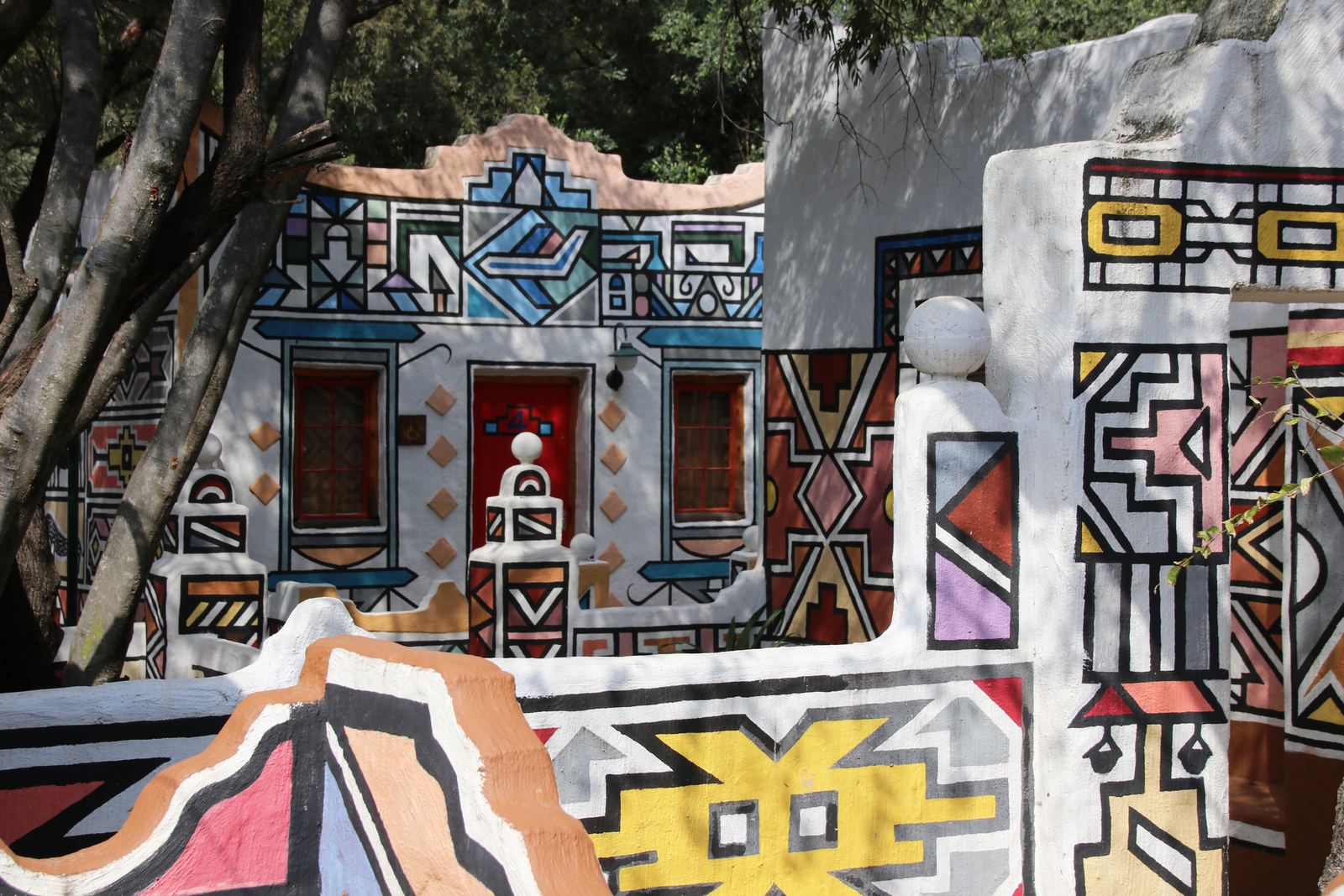
Walls of a homestead painted with bold geometric Ndebele patterns in black, white and bright colors

Painted Ndebele homestead: Angela Abel, CC BY 4.0

Walls that speak

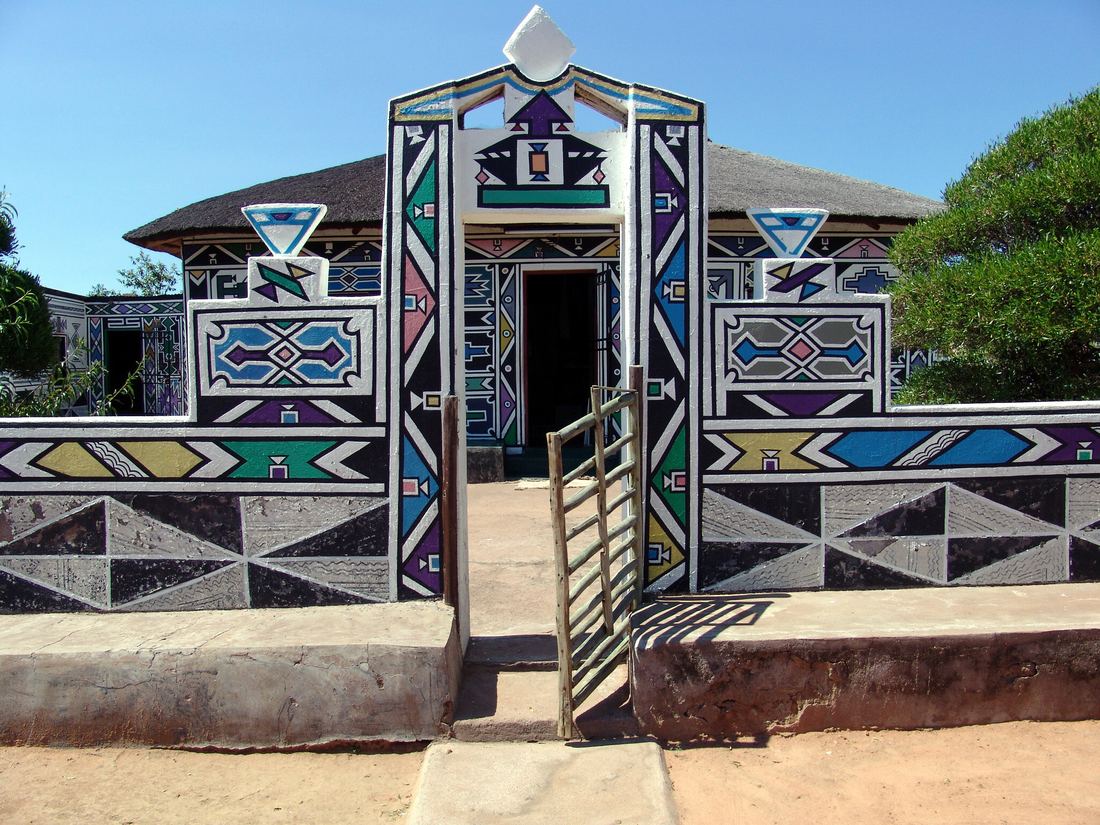
In the rural areas of Mpumalanga and Gauteng in South Africa, the homesteads of the Southern Ndebele people stand out from far away. Their outer walls and courtyard walls are covered in bold geometric designs: steps, triangles, chevrons and stylised shapes, each block of color edged in a thick black outline against a white background.

The painters are traditionally women, who learn by helping their mothers and grandmothers. Designs are painted freehand, often without any sketch. A newly painted home can mark an important family event, such as the end of a son's initiation or a wedding.

Video: South African artist, 81, keeps Ndebele traditions alive (AFP News Agency), embedded from YouTube.

From earth pigments to acrylic

Early Ndebele wall decoration used natural materials: clay, ochre, soot, lime and cow dung, applied with fingers, feathers or twig brushes. Bright commercial paints became available in the mid-20th century, and the palette grew to include blue, green, yellow and pink. Painters say the patterns can show family identity, celebrate modern life, or simply express personal taste, and some include letters, numbers, lamps and buildings drawn from the world around them.

Identity in hard times

Historians often link the flowering of the painted style to the late 19th and 20th centuries. After defeat in war against the Boer republic in 1883, the Ndebele lost their land and were scattered as labourers on white-owned farms. Painting homes in a distinct, recognisable style became one way to keep a shared identity alive under colonial rule and later apartheid.

Beadwork grew alongside the painting and shares its bold geometry. Ndebele women make beaded aprons, blankets, neck rings and headbands, and the style of a woman's dress and beadwork traditionally showed stages of life, such as girlhood, marriage and motherhood. Many of the same patterns move freely between walls, cloth and beads.

Esther Mahlangu and the wider world

The best known Ndebele painter is Esther Mahlangu, born in 1935, who learned from her mother and grandmother. In 1991 she became the first woman and the first African artist to paint a BMW Art Car, and her work has been shown in galleries and on design projects around the world. She also teaches young people at her home in Mpumalanga, passing the tradition on. Cultural villages such as the Botshabelo heritage site show the painting and beadwork to visitors, while families continue to paint their own homes.
Media credits

Text written by Bongara Bongara.

← Kente ClothGreat Zimbabwe →

Shop

The Bongara Bongara collection

Tees and hoodies in the Bongara Bongara colors, printed to order in the USA. Use code FIRST15 from the newsletter for 15% off your first order.

Watch

Bongara Bongara Shorts

Quick, accurate, under a minute. Every Short is original and made only for this channel.

YouTube @BongaraBongara
Channel launching soon. Subscribe on the newsletter to hear first.
Get notified
A whole country is named after this stone cityPhotos: Great-zim-aerial-looking-West.JPG - Janice Bell (CC BY-SA 4.0) via Wikimedia Commons | Great inclosure - Great Zimbabwe (15).jpg - Fanny Schertzer (CC BY 3.0) via Wikimedia Commons | Western Entrance to the Great Enclosure - Great Zimbabwe II (46698655045).jpg - Andrew Moore from Johannesburg, South Africa (CC BY-SA 2.0) via Wikimedia Commons | Great Zimbabwe Ruins.jpg - Trinapee (CC BY-SA 4.0) vi
Jollof rice is named after an old West African empirePhotos: Jollof rice with vegetable.jpg - Segun Famisa (CC BY-SA 4.0) via Wikimedia Commons | Ghana Jollof Rice with Chicken.jpg - Queen Murja10 (CC BY-SA 4.0) via Wikimedia Commons | A Nigeria Jollof Rice with chicken.jpg - Ei'eke (CC BY-SA 4.0) via Wikimedia Commons | Jollof rice and plantain.jpg - Lyndadelz (CC BY-SA 4.0) via Wikimedia Commons | Thieboudienne.JPG - KVDP (Public domain) via Wikimedia Com
Kente cloth is woven in strips as wide as your handPhotos: Different Kente cloth, Tafi, Volta region.jpg - Warmglow (CC0) via Wikimedia Commons | Ewe kente 2, Ghana.JPG - ZSM (CC BY-SA 3.0) via Wikimedia Commons | Kente Cloth making.jpg - Lauren Gardenbelle Fritts (CC BY-SA 2.0) via Wikimedia Commons | Kente weaving 06.jpg - daSupremo (CC BY-SA 4.0) via Wikimedia Commons | Kente weaver in a loom.jpg - Kwameghana(Bright Kwame Ayisi) (CC BY-SA 4.0) via Wiki
Librarians smuggled a whole library out of TimbuktuPhotos: Timbuktu-manuscripts-astronomy-mathematics.jpg - Elias Altmimi (Public domain) via Wikimedia Commons | Timbuktu-manuscripts-astronomy-tables.jpg - Unknown authorUnknown author (Public domain) via Wikimedia Commons | Sankore Moske Timboektoe.JPG - Baz Lecocq at nl.wikipedia (CC BY 2.5 nl) via Wikimedia Commons | Sankore Madrasah.jpg - Dr. Ondřej Havelka (cestovatel) (CC BY-SA 4.0) via Wikimedia Com
This African drum can actually talkPhotos: TalkingDrum.jpg - see file page (CC BY-SA 3.0) via Wikimedia Commons | Talking drum made by me.jpg - Danotech (CC BY-SA 4.0) via Wikimedia Commons | Wooden drum locally called "DUNDUN" from Ibadan, Oyo state.jpg - Stephanie cheks (CC BY-SA 4.0) via Wikimedia Commons | Yoruba Talking Drum Performer in Nigeria.jpg - Tijani Taofeek Bamidele (CC BY-SA 4.0) via Wikimedia Commons | African drummers.jpg
Newsletter

One country, one story, every week

Each week we spotlight one African country: a place to know, a dish to cook, a song to play and a phrase to learn. You also get new pages and Shorts first.