
African Recipes, Country by Country
There is no single African cuisine, any more than there is a single European one. A Moroccan couscous, an Ethiopian stew on injera and a Congolese palm-butter chicken come from different climates, crops and histories.
Below are signature dishes from across the continent, each tied to the country or region that knows it best, followed by two simple recipes you can cook tonight.
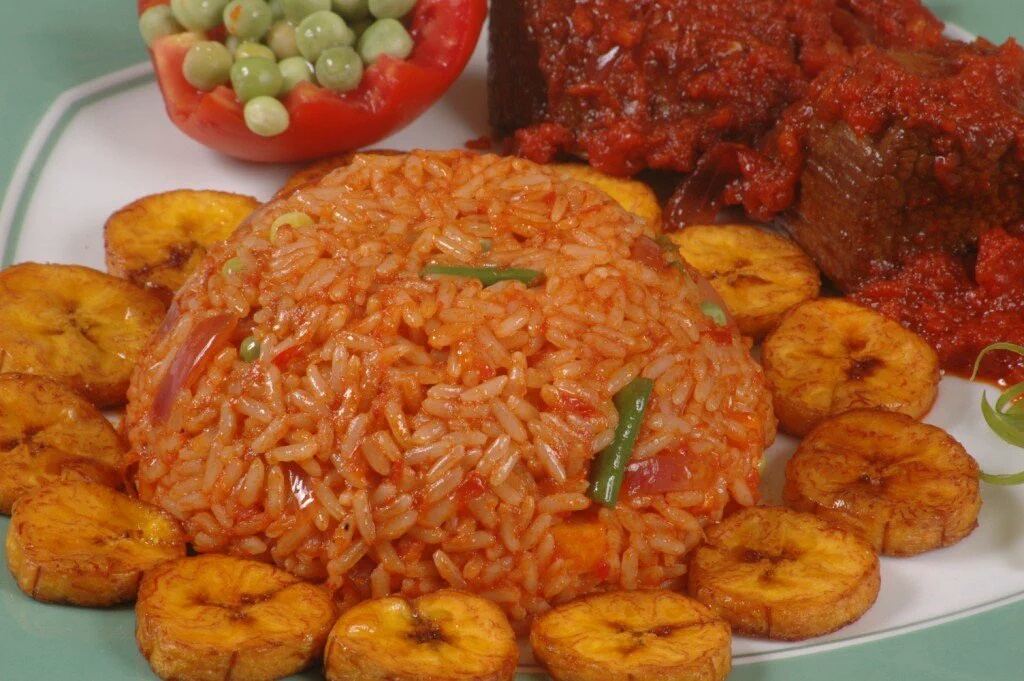
Jollof rice with fried plantain: Skarfmacaronne, CC BY-SA 4.0
Dishes to know
Ceebu jën (thieboudienne)
Fish, broken rice and vegetables cooked in a rich tomato sauce, created by the fishing communities of Saint-Louis. It is eaten from a shared platter and was added to UNESCO's heritage list in 2021. Many cooks see it as an ancestor of jollof.
Jollof rice
Rice cooked in a tomato, pepper and onion base, named after the Wolof Jolof Empire. Ghanaians and Nigerians argue happily over whose version is best. Our full story and recipe are on the jollof page.
Egusi soup
A thick soup built on ground egusi seeds from melon and gourd plants, cooked with greens, peppers and meat or fish. It is eaten with a swallow such as pounded yam or fufu, pinched off by hand and dipped.
Kelewele
Cubes of ripe plantain tossed with ginger, chile and salt, then fried until the edges caramelize. Sold as street food at night and often paired with roasted peanuts. Our recipe is below.
Injera and wat
A spongy, tangy flatbread of fermented teff that serves as plate and spoon for stews spiced with berbere. Our injera page explains the fermentation and has a recipe.
Couscous and tagine
Hand-rolled, steamed semolina is a shared heritage of Algeria, Mauritania, Morocco and Tunisia, recognized by UNESCO in 2020. In Morocco it sits alongside the slow-cooked tagine.
Koshary
Rice, lentils and pasta layered with spiced tomato sauce and crisp fried onions. A cheap, filling street-food classic, written about by a European traveler in Suez as early as 1853.
Ugali and sukuma wiki
Ugali is a firm maize porridge rolled into a ball with the right hand and used to scoop. It is eaten with sukuma wiki, collard greens with onion and tomato. Neighbors know similar porridges as nsima, sadza and pap.
Moambe chicken
Chicken simmered in palm butter made from palm nuts, often with greens and chile, served with rice or cassava. It is regarded as a national dish in all three countries.
Bobotie
Spiced minced meat with dried fruit, baked under an egg and milk custard and served with yellow rice. It is closely linked with the Cape Malay community of the Western Cape.
Two recipes to cook tonight
Kelewele: Ghanaian spiced fried plantain
Serves 4 as a snack or side. Use ripe plantains that are yellow with plenty of black spots: they are sweet enough to caramelize but still hold their shape.
- Make the spice paste Grate 1 tbsp fresh ginger and half a small onion into a bowl. Stir in 1/2 tsp cayenne (or to taste), 1/2 tsp salt and 1 tbsp water.
- Cut the plantains Peel 3 ripe plantains and cut them into cubes about 3/4 inch (2 cm) across.
- Season and rest Toss the plantain with the spice paste until coated. Let it sit for 15 minutes so the flavors soak in.
- Fry Heat about 1 1/2 inches (4 cm) of neutral oil in a deep, heavy pot to 350°F (175°C). Fry the plantain in small batches for 3 to 4 minutes, turning, until deep golden with dark caramelized edges.
- Drain and serve Lift out with a slotted spoon onto paper towels. Serve hot, with a handful of roasted peanuts on the side.
Tip: If the oil is not hot enough, the plantain soaks it up and turns greasy. Never leave hot oil unattended, and keep a lid nearby.
Sukuma wiki: East African braised greens
Serves 4 as a side. The Swahili name means push the week, because these greens are cheap and stretch a meal. Serve with ugali, rice or chapati.
- Prepare the greens Wash 1 large bunch of collard greens (about 1 lb / 450 g). Cut out the thick stems, stack the leaves, roll them up and slice into very thin ribbons.
- Soften the onion Heat 2 tbsp oil in a wide pan over medium heat. Cook 1 chopped onion for about 5 minutes until soft and golden at the edges.
- Add tomatoes Add 2 chopped tomatoes and 1/2 tsp salt. Cook, stirring, for about 5 minutes until they break down into a thick sauce. Add a chopped fresh chile here if you like heat.
- Cook the greens Add the greens and 2 tbsp water. Stir and cook uncovered for 5 to 8 minutes, until tender but still bright green.
- Season and serve Taste and adjust the salt. Serve straight away while the greens are vivid.
Tip: Cut the greens as thin as you can. Thin ribbons cook fast and stay green instead of turning dull and soft.
- UNESCO: Ceebu jën, a culinary art of Senegal
- UNESCO: Knowledge, know-how and practices pertaining to the production and consumption of couscous
- Wikipedia: Thieboudienne
- Wikipedia: Egusi
- Wikipedia: Kelewele (fried plantain)
- Wikipedia: Berbere
- Wikipedia: Koshary
- Wikipedia: Ugali
- Wikipedia: Sukuma wiki
- Wikipedia: Moambe chicken
- Wikipedia: Bobotie
Facts on this page were checked against these sources (updated Oct 1, 2026). Spot an error? Email hello@fireempireshop.com.